Monday, September 1, 2014

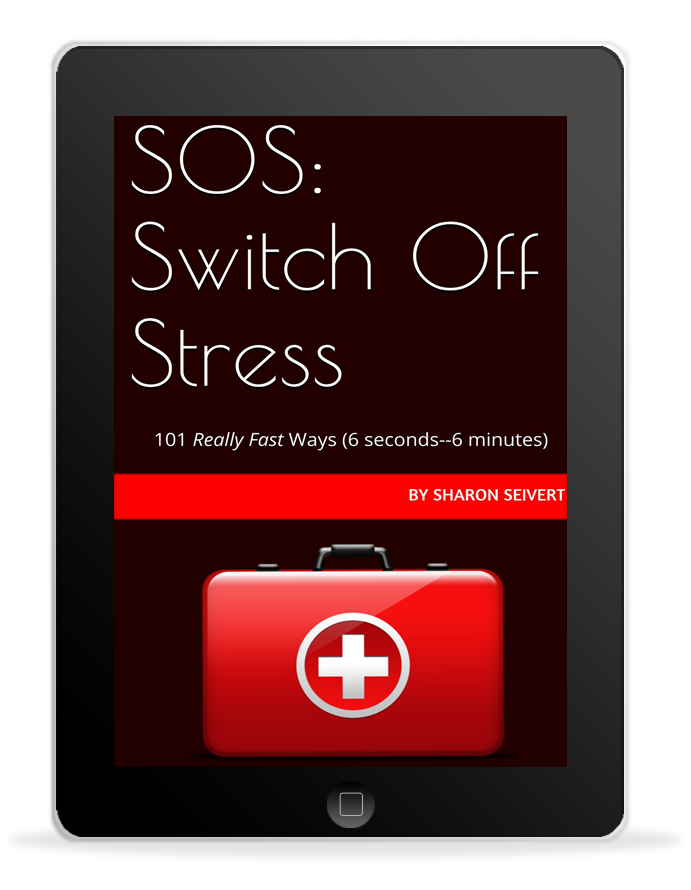
Great news: SOS is in print and at the iStore!

Now that your vacation's over, don't let stress creep back! Get immediate relief from toxic stress by Switching Off Stress in 6 seconds to 6 minutes.


Read more about what SOS can do for you or order directly: evaBook or iBook ($8.99), print book + website ($11.69)--and don't forget to take a FREE stress quiz for your own personalized stress report.

As you can see, my summer vacation was spent creating an SOS iBook and a new print version that maintains the original evaBook's "6 second to 6 minute" promise via a companion webpage with links to all instructions and resources. 

Have a great day! - Sharon

Monday, August 18, 2014

MAKING CHANGE

Changing ingrained habits is extremely difficult. This is true even when that change is vital for survival. In fact, according to groundbreaking research by Alan Deutschman, only 1 in 9 people will actually make a sustainable lifestyle change—even if they are told that they must Change or Die (the title of his excellent book). Deutschman discovered that people do not respond in any lasting way to the 3 “Fs” (Fear, Force or Facts), so change efforts based on those are not going to work well.

However, better than 90% of Deutschman’s subjects successfully made long-term changes when they followed the three “Rs” (Reframe, Relate, Repeat). My colleagues and I were thrilled to discover Deutschman’s work because his three “Rs” are contained within the six steps of The Coreporation's CHANGE process—and show in part why we have been so successful in helping clients make lasting changes in life, relationships and work. 

The Coreporation's pragmatic, easy-to-follow CHANGE process is outlined in the image below. These six steps reflect the 5 Elements of Success and Synergy, which provide a holistic and systemic context for Deutschman’s recommended three “R” steps in Change or Die.


Step 1. Reset (Core): When you recognize things are not working well: stop, pause, and get quiet internally. Don’t push yourself to keep going. Instead, become more effective, productive and creative by taking a vital moment to self-reference before starting over. This is a bit like refreshing, restarting or rebooting your computer.

Step 2. Reframe (Vision): Rethink the situation; envision a different future; be inspired with hope; know that change and happiness are possible. Ask pragmatic questions (what is working well, what is not, and why) so you can change the consciousness that created this problem in the first place. 

Step 3. Re-prioritize (Mission): With this new mental framework, set a strong intention, clarify your priorities, set goals and a clear direction, and then move into action. This revitalization will help you overcome old obstacles as you move decisively into creating the new future you desire. 

Step 4. Relate (Interactions): Develop healthy relationships with people who will help you sustain hope, energy, and action. Let go of, or strongly boundary, those relationships that are less healthy and happy for you. Use your emotional GPS to navigate your way and make course corrections. 

Step 5. Repeat (Structure): Over time, steadily build more functional habits and skills; keep at it until these changes become your new reality. Implement your learning and new skills by putting them into daily practice so you can grow gradually into all the greatness of which you’re capable.  

Step 6. Reform (Synergy): When these 5 steps connect, you will have an increased ability to powerfully re-form yourself from the inside out. This is how the change you originally desired becomes thoroughly integrated into your daily life and work until you have a whole new way of being.  Because you determined to reclaim your personal power and responsibility, you will experience a steady evolution that generates more energy, a greater experience of ease, and perhaps even a positive revolution (miracle) in your life. 

The Coreporation's CHANGE process is built on Sharon Seivert's book, The Balancing Act. The Balancing Act is a very familiar, daily, ongoing dance for most people, in which they make constant adjustments in response to the many challenges life throws their way.

This CHANGE process teaches you how best to adapt to changing circumstances: it stimulates your intuition and creative problem-solving capabilities, improves your resilience, and increases your practical knowledge, energy and excitement as you achieve more and more of your goals. Furthermore, this incremental growth process of balancing and counterbalancing allows you to turn insights and small successes over time into a growing conviction that you have everything you need to realize your objectives. 

The Balancing Act's Change process contains not only Deutschman’s three “Rs” for successful personal change, but also some clues about how to create lasting change in organizations. This formula outlines the classic four-part PDCA and Action-Learning cycles used in businesses for total quality improvement. By adding the central Core element at the beginning of these four steps and Synergy at the end, this cycle is transformed into an even more effective upward spiral, i.e., (Be) -  Plan/Think - Do/Act - Check/Reflect - Implement/Have - (Transform). 

And lastly, here's an acronym that will make The Coreporation's CHANGE formula very easy for you to remember: 

CHANGE…
  • Comes from Centering in your Core
  • Holds your Hopes and choice to be Happy
  • Always moves you into Action
  • Navigates to success via emotional GPS
  • Grows your capacity for Greater…
  • Ease, Energy, and ongoing Evolution.

CHANGE =  Center + Hope + Act + Navigate + Grow + Evolve

Tuesday, June 3, 2014

New England Women's Leadership Institute                  June 11, 2014

Join Sharon at the NEWLI on June 11th:
Where she will speak about "Blasting Through Stress (for you AND Those You Lead)"
Excessive stress can turn a talented leader into a dysfunctional one in very short order. Distress is subtle, insidious, corrosive, and often denied (“What me–stressed!?”). It moves from stimuli to brain to body to others around you like a lightning bolt that strikes before you know what hit you.

Stress robs leaders of their talent. It destroys great work, slows progress, causes illness, and strains relationships.  That’s why talented leaders need to stop distress as quickly as possible, before it causes real harm. This hands-on, fun session is based on Sharon Seivert’s latest book, SOS: Switch Off Stress (101 Really Fast Ways). 

In this session, you will take a short Elemental Stress Quiz that points out where stress affects you most severely. Then you will learn several highly effective techniques that will take only 6 seconds to 6 minutes to experience relief in your most vulnerable area of stress.
This practical seminar is designed to help both leaders and the people they lead (especially since stress so often flows downhill in organizations!)
Takeaways:
  • Learn about 6 distinctly different kinds of “elemental” stress.
  • Discover your weakest stress area (where you’re most likely to contribute to the stress around you).
  • Learn several very fast ways to Switch Off Stress (in 6” – 6‘).
  • Discover your strongest Element of Success to leverage.

Speaker:   Sharon Seivert, President, The Coreporation

Sharon SeivertSharon Seivert is President of The Coreporation (a business consulting firm) and its non-profit affiliate, Core Learning Services. She is author of The Balancing Act, SOS: Switch Off Stress, many other books and numerous assessments.


To Learn More or Sign up: 

http://www.newli.org/2014-womens-leadership-summit-event-program/

Saturday, May 31, 2014

Enjoy an Experience of the Elements of Success!

I have recently revised the audio experiences for the Elements of Success, making them easier to access via YouTube.  These audio/videos will enhance your experience of both The Balancing Act and SOS: Switch Off Stress. 

Here they are for your listening pleasure:


The Core: 


Go here if you're feeling anxious, lost, or bad about yourself so you can become more calm, steady and gain access to your brilliant intuition so you know how to improve your situation. 


Vision: 


Go here if you're feeling uninspired, pessimistic, or just crabby--and would like to shift to more hope and creativity.


Mission:


Go here if you're feeling stuck, lost and unmotivated,  and want to increase your energy and spark some action.


Interactions: 


Go here if you're feeling "off" emotionally, and want to reconnect to at the heart between yourself and those you love. 


Structure:


Go here if you feel stressed by money or organizational matters and would like to to feel more solid, steady, connected to the earth.


Synergy: 

Go here if you feel isolated, and want to feel reconnected, a part of something larger than yourself.

Announcing: SOS is now available in Print!


I am absolutely delighted to announce that SOS is now available in BOTH print and evaBook forms.  

It took me this past month to respond to the many requests for a print version of SOS. My major concern was to somehow maintain the evaBook's "6 second to 6 minute" timeframe for these 101 activities. 

I'm happy to report that I DID IT! (I created a companion SOS webpage that contains links to all SOS instructions/resources.) 

Get immediate relief from toxic stress! 

The choice is yours: print book + web resource ($11.69) or the evaBook ($8.99) Or, read more about SOS here!


The next blog will contain direct links for the updated versions of the Balancing Act "SOS" elemental audios--all of which are now available on YouTube! These will provide you with immediate relief from distress by directly experiencing the healing qualities of each one of the Elements of Success. 

Have a great day! - Sharon

Wednesday, April 2, 2014

Announcing the Free & Fast SOS Stress Quiz!


Find out which one of 6 Types of Stress hits you hardest. 

If you've yet not taken 2-3 minutes to complete the new SOS Quiz and gotten your free report, go here. If you have already completed the SOS quiz and have your report, you can read more about your primary kind of stress below--and you can also access an audio to get some immediate relief. 

Stress Type #1: CORE STRESS. You feel agitated, anxious, off-balance, uncomfortable in own skin; have low self-esteem, confidence, resilience; feel generally unhappy; take things too personally; feel unclear about life purpose, values, what’s important; don’t breathe deeply or sleep well; are too busy to relax or take breaks; run from one thing to the next; feel “empty” inside, not best self; have addictions can’t seem to stop (smoking, drinking, eating, etc.).

Reduce Type 1 Stress now by listening to Core audio on the TCI home page.  


Stress Type #2: VISION STRESS. You are bothered by mental looping, negative thinking, a hyper-active or critical mind; are doubtful and afraid too often; get stuck because over-analyze, over plan, over think; feel uncreative, uninspired, can’t generate good options; have a bad attitude, lack humor; don’t enjoy things or have as much fun these days; feel bored, unchallenged, uninteresting in new information/learning, not as smart as used to be.

Reduce Type 2 Stress now by listening to Vision audio on the TCI home page.  


Stress Type #3: MISSION STRESS. You procrastinate too much; have a hard time figuring out priorities or making choices; feel undisciplined, dissipated, unfocused, unmotivated; feel overwhelmed &/or burned out; lack direction, so are hesitant about moving into action and reluctant to take initiative; feel micro-managed and demoralized; avoid conflict; don’t feel energetic, ambitious, excited, proud of accomplishments.


Reduce Type 3 Stress now by listening to Mission audio on the TCI home page.  


Stress Type #4: INTERACTIONS STRESS: You feel emotionally “off” (either too emotional, emotionally flat, or somehow inappropriate in interactions); have key relationships that are unhealthy, unsupportive, draining, disrespectful or that keep you stuck; feel unappreciated, used, resentful, manipulated or exhausted from over-giving; would rather be isolated than involved now because don’t feel particularly pleasant, empathetic, compassionate or caring.
Reduce Type 4 stress now by listening to Interactions audio on TCI home page.  

Stress Type #5: STRUCTURE STRESS. You have difficulty managing or securing money, space, tools, &/or other physical resources you need; are impractical, unrealistic, unorganized; have trouble following directions and keeping things orderly; can’t be depended upon to complete tasks or meet deadlines; don’t take good care of physical health or possessions; have dysfunctional habits that undermine what you want to create; feel unsafe, insecure.
Reduce Type 5 Stress now by listening to Structure audio on the TCI home page.  

Stress Type #6: SYNERGY STRESS. You're having a run of bad luck; feel less effective and balanced overall; seem to have lost good judgment, discernment, a sense of perspective; don’t experience flow or ease, so things take too much time and effort; don’t feel particularly grateful or happy because others are better off; lack a sense of a connection to a Whole, Context, or the infrastructures that support your work, life and relationships.
Reduce Type 6 Stress now by listening to Synergy audio on TCI home page.  


And if want all 101 SOS stress reduction techniques to quickly reduce any kind of stress you're feeling, get SOS: Switch Off Stress or read more about it here. You can read this book on your Mac, iPad, PC, smart phone or tablet with this FREE Kindle Reader App:

Have a great day, 
Sharon Seivert

Thursday, March 13, 2014


Loving Family and Friends: 

Tending & Befriending


This is a personal post that celebrates the fact the four Seivert Siblings all have birthdays within one month of each other (from 2/18 to 3/17). We are, from left to right: Dorothy, Irene, me, and Tom on vacation this past summer. 

This is the month in which we celebrate how lucky we are to have been born into the same family.  My siblings are truly wonderful people whom I admire greatly. Through the years we have helped each other relieve both major and minor stresses that come with the major and minor life crises we have shared. (We also have occasionally caused each other stress, but we won't go there now :-) 

Over the years, I feel we have taken very good care of each other--and I want to acknowledge how much I love them and how grateful I am to have them in my life. I also want to celebrate that, in addition to my great siblings, I am  blessed with many wonderful extended family members such as my parent's siblings (my aunts and uncles), and terrific cousins, in-laws, nieces & nephews. 

Actively caring for each other is a great SOS technique. In fact, researchers now indicate that Tending and Befriending is a highly effective stress reliever that is used throughout the human and animal kingdom. As it turns out, it is an excellent alternative to the much more well-known survival stress responses of "Fight or Flight".  In sharp contrast to the often  harmful harmful health effects of over-relying on Fight or Flight, Tending and Befriending has many positive, long-lasting health benefits (see below).


SOS #55: Tend and Befriend

(3-4 minutes)

One of the greatest stress relievers known to humanity is to care for and spend time with the people you love. Tending is when you do nurturing activities, such as caring for offspring or someone who is injured: protecting them, feeding them, ensuring their safety and wellbeing, and reducing their distress. Befriending is when you create and maintain friendships and family relationships, forming strong social networks that perform many of the same functions as tending.  Animal and human studies suggests that reproductive hormones may be at the core of this powerful alternate response to stress.

Here are some ways Tending works as an SOS activity. Let’s say you get home from work, and then put your concerns aside for a few moments as you listen attentively to your child’s excited stories from the day. (Poof! In just a couple minutes, whatever stressed you is forgotten.)  Befriending relieves your stress similarly--for example, when you reach out to be with good friends, call a sibling, and/or send notes to members of your personal, professional or social communities. It only takes a few minutes to pick up the phone, connect via Skype, FaceTime, or by texting or emailing a friend or family member. You can also drop by a favorite colleague’s desk or a neighbor’s home and arrange to meet for lunch, supper, coffee, or a healthy walk. (Again, poof—your stressors are replaced by the good feelings that come from tending and befriending.)

Tending and befriending can be used to help you build and expand strong communities—whether family (I just attended an uncle's birthday party via Skype), professional (I meet regularly with colleagues and clients via GHO), neighborhood, nation, or world. Tending and befriending is an SOS technique that reduces not just your own, but also many other peoples’ stress by preventing social isolation.  And social isolation, as we’re only now learning, is a major health hazard. indeed, scientists now argue that the health risks from loneliness are greater than those from smoking or obesity! 

In sharp contrast, a meta-analysis of 148 studies showed that people with strong social systems (those who tend & befriend) have a 50% greater likelihood of survival of their medical problems! This extraordinary mental and physical health phenomenon was consistent across age, gender, initial health status, pre-existing conditions and other factors. 

As it turns out, tending and befriending are great survival tools for you and all those you love.  So don't waste another minute -- reach out to tend and befriend someone! It will make your stress AND theirs go away (Poof!)

Learn more about SOS #55


Historically, the primary human stress response has been characterized, both physiologically and behaviorally, as "fight-or-flight."  But we do have other choices: we can also respond to distress by "Tending and Befriending". 

Tending involves nurturing activities designed to protect the self and offspring that promote safety and reduce distress. Befriending is the creation and maintenance of social networks that may aid in this process. The bio-behavioral mechanism that underlies the tend-and-befriend pattern draws on the attachment-caregiving system. Neuroendocrine evidence from animal and human studies suggests that oxytocin, in conjunction with reproductive hormones may be at its core. This previously unexplored stress regulatory system has many implications for curing much of the stress that is rampant around the world.

Unfortunately, many people are underdeveloped in our tending and befriending survival strategy. In fact, in the past three decades the percentage of individuals who consider themselves lonely in the US has risen from 20% to a whopping 40%!  The health risks from loneliness are significant: people who feel lonely are more likely to have an impaired immune system and untreated mental health issues (which in turn can cause the kinds of violent outbursts that turn into headline news). People who are socially isolated recover more slowly from surgery, and have greater risks of inflammation, heart disease, and premature death. 

Note: Social isolation is reduced only by real human contact. No matter how many Facebook “friends”, Linked In connections, or Twitter followers you have, you can suffer from social isolation. Tending and Befriending is a low-tech SOS strategy AND an incredibly powerful one. It shows that, in very real ways, when you reach out and welcome someone into your life, your social circle, or your neighborhood, you are helping to heal yourself, them, and the world.


COMING SOON:


I will be sending you a birthday gift sometime in my birthday month--a new audio meditation  that was suggested to me (actually demanded of me) by an enthusiastic client.  Consider it a thank you to my entire community of extended family, friends, clients, colleagues, and readers for the many ways you've tended and befriended me over the years.


GOOD LUCK!!

If you want to tend to those you love by providing them some stress-relief, go here to purchase SOS: Switch Off Stress (only $8.99 for this 258-page-equivalent "evaBook"). You can also read more about the value SOS can offer you and all those you love.

You may also want to give people you care about The Balancing Act, which is the foundational work upon which SOS is built.  Learn all about TBA here. (It's available in both print and eBook versions.)


And here's a link for a
 Free Kindle App so you can read SOS or TBA on any PC, MAC, tablet, or smart phone.